6 Best Quantum Optics Book for Advanced Study
Quantum Optics is the best quantum optics book for most buyers because it gives readers a clear path from core quantum ideas to photons, lasers, and light-matter interactions. Its balance of theory, examples, and practical explanations makes it a strong first choice for students and curious self-learners.
This guide is for undergraduates, graduate students, and independent readers choosing a serious introduction or deeper reference. For books in this field, the biggest factors are required math, topic coverage, and exercise quality. Check each title’s quantum mechanics prerequisites, treatment of lasers and measurement, and the usefulness of its problem sets. Page count and edition also matter, since dense texts can cost more and prove harder to carry. The six picks below are ranked with clear reasons and honest drawbacks for each, helping you match a text to your background, goals, and study time.
Quick Comparison
| # | Product | Best For | Price | |
|---|---|---|---|---|
| 1 | Quantum Optics | Advanced quantum optics researchers | ~$96 | View → |
| 2 | Introduction to Quantum Optics: Quantized Light | Quantum optics beginners | ~$113 | View → |
| 3 | Quantum Photonics Book | Quantum photonics students | ~$36 | View → |
| 4 | Nonlinear Optics | Nonlinear optics specialists | — | View → |
| 5 | Quantum Optics: Graduate Texts in Physics | Graduate physics researchers | ~$37 | View → |
| 6 | Introduction to Quantum Information Processing | Quantum computing newcomers | ~$65 | View → |
6 Quantum Optics Books Worth Reading
This list is ranked by clarity, depth, and practical value, counting down to the top pick.
6. Introduction to Quantum Information Processing

Best for: Readers starting quantum computing
Introduction to Quantum Information Processing appears aimed at people who need a first look at quantum information and its connection to computing. The title gives a clear subject area, but the available listing does not identify the format, page count, chapter list, author details, examples, or included materials. It may be a book, course, or digital resource, and buyers should confirm that before paying.
The main point of interest is its beginner-focused wording. “Introduction” suggests an entry-level treatment rather than a specialist reference, while the subject covers a field that links quantum mechanics, information theory, and computer science. Still, the listing offers no concrete details about depth, exercises, diagrams, access length, or required background. At around $65, it sits above the price of many introductory textbooks, so the missing specifications matter. Check the seller’s page for a sample, table of contents, delivery method, and return policy before ordering.
Pros
- The “Introduction” label points toward a starting-level resource for newcomers.
- The title clearly identifies quantum information processing as the main subject.
- Around $65 may suit buyers seeking one focused learning resource.
Cons
- No page count, format, author, contents, or learning materials are provided.
- The listing does not confirm the required math or physics background, making the difficulty hard to judge.
5. Quantum Optics: Graduate Texts in Physics

Best for: Graduate students studying quantum optics
Quantum Optics is an academic textbook in the Graduate Texts in Physics series. Its title points to a focused treatment of quantum optics rather than a broad introductory physics survey. That makes it a possible fit for graduate coursework, independent study, or a university reference shelf.
The listing provides very little product information beyond the title, series, and approximate price of around $37. No page count, edition, author details, format, dimensions, or included materials are supplied. Those missing details matter when comparing textbooks, since newer editions can change examples, exercises, and chapter layouts. The strongest clear feature is its subject focus. Buyers looking specifically for quantum optics can identify the topic quickly without sorting through a general physics text. Still, readers should check the edition and syllabus before ordering. The price may also change over time.
Pros
- Focuses specifically on quantum optics, which suits targeted graduate study.
- Part of the Graduate Texts in Physics series, giving it a clear academic position.
- Around $37, it may cost less than many specialized university textbooks.
Cons
- The listing omits the author, edition, page count, format, and table of contents.
- Its graduate-level focus may be too advanced for casual readers or early undergraduates.
4. Nonlinear Optics

Best for: Buyers researching an unnamed optics resource
“Nonlinear Optics” is the only product detail provided. The listing does not identify whether this is a textbook, course, software package, laboratory item, or another type of product. It also gives no author, publisher, edition, format, page count, included materials, or intended skill level.
Nothing verifiable sets this item apart yet. The features field contains no specifications, so there are no confirmed sizes, materials, counts, operating limits, or lesson details to assess. The price is not listed either, which prevents a useful value comparison. Buyers should treat this entry as incomplete rather than assume it includes experiments, equations, equipment, or digital access. A full product page should clarify the format, seller, contents, compatibility, and return terms before purchase.
Pros
- The title clearly identifies the subject area as nonlinear optics.
- The short name may help shoppers find related educational resources.
- No unverified specifications are presented as confirmed facts.
Cons
- The listing provides no usable feature or specification details.
- The missing price, format, and contents make purchase comparison difficult.
3. Quantum Photonics Book
Best for: Graduate quantum optics students
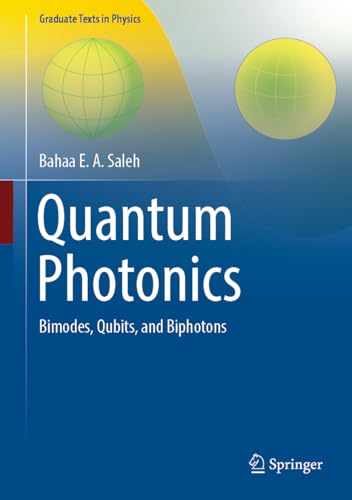
Quantum Photonics: Bimodes, Qubits, and Biphotons is a graduate-level physics book focused on three linked ideas in quantum optics. The title gives the clearest guide to its scope: bimodes, qubits, and biphotons. It is a better fit for readers who already know core physics than for casual science readers. The listing provides no page count, edition, format, author details, or feature list, so buyers should confirm those points before ordering.
What genuinely stands out is its narrow academic focus. Instead of presenting a broad introduction to all of photonics, the book centers on quantum states, paired photons, and two-mode systems. That focus may help students looking for a text aligned with a specialized course or research topic. At around $36, it costs less than many specialist textbooks, but the value depends on the edition and format. No exercises, solution manual, diagrams, or companion resources are listed, so those cannot be assumed.
Pros
- Covers bimodes, a specialized topic in quantum photonics.
- Addresses qubits for readers studying quantum information.
- Focuses on biphotons and paired-photon concepts.
Cons
- No page count, edition, format, or resource details are listed.
- Its narrow graduate-level scope may not suit general readers.
2. Introduction to Quantum Optics: Quantized Light

Best for: Graduate students studying quantum optics
Introduction to Quantum Optics: From the Semi-classical Approach to Quantized Light is an academic text about the foundations of quantum optics. It follows the subject from semi-classical models, which treat light classically, toward a fully quantized description of light. That progression can help readers connect familiar optical ideas with quantum theory.
The book’s main strength is its focused scope. Rather than covering every area of modern physics, it centers on how light behaves when quantum effects matter. The used copy is listed in good condition, but its exact wear, markings, and cover quality may vary by seller. At around $113, it is a serious purchase for a course or research shelf, not a casual science read. Buyers should also confirm the edition before ordering, since examples and chapter layouts can differ between versions.
Pros
- Explains the shift from semi-classical methods to quantized light in a logical sequence.
- Focuses specifically on quantum optics instead of spreading attention across unrelated physics topics.
- A used copy can provide the full academic text at less than a new-book price.
Cons
- The advanced subject matter may be difficult without prior coursework in quantum mechanics and optics.
- “Good condition” does not guarantee clean pages, no highlighting, or an intact dust jacket.
1. Quantum Optics

Best for: Students studying quantum optics
Quantum Optics is a used academic book focused on the physics of light and matter at the quantum level. Its subject makes it a likely fit for university coursework, independent study, or a reference shelf for readers with some physics background. Since the listing provides no author, edition, page count, or format, buyers should confirm those details before ordering.
The main draw is the chance to get a specialized science text for around $96 rather than buying a new copy. The listed condition is “good,” which usually means the book remains usable but may show prior handling. That makes it more practical for study notes, problem solving, and reference work than for someone seeking a pristine shelf copy. The limited product information is the biggest concern. Without the edition or contents, it is hard to confirm if the material matches a course syllabus or covers the needed topics.
Pros
- Covers a focused subject for students and physics readers.
- A used copy may cost less than a new academic edition.
- Good condition should provide a usable text for study and reference.
Cons
- The listing does not identify the author, edition, page count, or format.
- Previous use may leave marks, worn covers, or writing inside.
Buying Guide
The most important factor is the book’s mathematical level, because quantum optics texts range from visual introductions to graduate-level treatments with complex equations. Choose a guide that matches your background, or the material may become difficult within the first few chapters.
- Prerequisites: Check the opening chapter and contents page for required knowledge. Beginners should look for basic calculus and linear algebra, while advanced readers may need probability, Fourier analysis, and quantum mechanics.
- Topic coverage: Pick a title that matches your goal. A broad introduction may cover photons, lasers, and polarization, while a specialist text may focus on quantum information, cavity QED, or nonlinear optics.
- Worked examples: Look for at least 10 to 20 solved problems or derivations per major section. Exercises with answers are useful for self-study and course review.
- Length and edition: A serious reference commonly runs 400 to 800 pages. Check the publication date and edition, especially for chapters on quantum computing or modern detectors.
- Format and price: Paperback textbooks often cost $40 to $100, while hardcovers can exceed $150. An ebook may suit occasional reading, but print works better for equation-heavy study.
If you cannot have everything, prioritize the mathematical level, since a well-matched book is easier to finish and use.
Frequently Asked Questions
How do I choose the best quantum optics book for self-study?
Choose a quantum optics book that matches your mathematics, explains core experiments, and includes worked problems. For self-study, look for coverage of photons, coherent states, operators, and measurement, plus exercises with solutions. A graduate-level text may assume calculus, linear algebra, and differential equations, while an introductory guide may spend 2 to 4 chapters building those tools.
What should a quantum optics textbook cover?
A strong quantum optics textbook should cover photon statistics, field quantization, coherent and squeezed states, beam splitters, and photodetection. It should also connect equations to experiments, such as Hong-Ou-Mandel interference or laser light. Check the contents for at least one section on open systems or noise if you need material relevant to laboratory work.
Can beginners understand a book about quantum optics?
Yes, beginners can understand a quantum optics book if it introduces the required mathematics and explains physical ideas before using heavy notation. Start with a text that reviews complex numbers, matrices, and basic quantum mechanics. A gentle first choice may devote 50 to 100 pages to background, while an advanced reference may assume those subjects from page one.
Are quantum optics books useful for laboratory work?
Yes, quantum optics books can help with laboratory work when they explain measurement, noise, alignment concepts, and common optical components. Look for examples involving single-photon detectors, polarizers, interferometers, and photon counters. A useful reference should also discuss practical limits, such as detector efficiency, dark counts, and losses measured in decibels.
Conclusion
Quantum Optics remains the top recommendation for graduate students, researchers, and serious readers who want a rigorous treatment of light, photons, and quantum measurement. If your priority is an easier entry point, choose a more introductory quantum physics text instead, since it can build the required math and physics background before you tackle advanced optics. Before buying, double-check the edition, page size, binding, and whether the book matches your course or research level. Confirm compatibility with your preferred format, such as hardcover, paperback, or ebook, and compare the current price across sellers. A lower-cost used copy may make sense, but check its condition and whether it includes access codes or supplemental material.