6 Best Dress Shoes for Extensor Tendonitis at Work
The UHIAGREE Wooden Shoe Stretcher is the top pick for most buyers seeking the best dress shoes for extensor tendonitis because it can add room across the instep and reduce pressure from a tight upper. It is a practical fit aid with adjustable length and width, so one pair of formal shoes may become more comfortable without replacing them.
This guide is for anyone who needs office, event, or formal footwear without aggravating the top of the foot. The key factors are a roomy toe box, soft upper materials, and enough adjustability to avoid pressure over the tendons. The six picks below are ranked with clear reasons and honest drawbacks for each, so you can compare comfort, fit, and value before choosing a pair or stretcher.
Quick Comparison
| # | Product | Best For | Price | |
|---|---|---|---|---|
| 1 | UHIAGREE Wooden Shoe Stretcher | Narrow leather dress shoes | ~$21 | View → |
| 2 | XYH Shoe Stretcher | Casual sneaker toe relief | ~$23 | View → |
| 3 | XYH Shoe Stretcher | Women’s flats width adjustment | ~$19 | View → |
| 4 | Ouligelonn Shoe and Boot Stretchers, 2 Pieces | Multi-pair boot owners | ~$35 | View → |
| 5 | HOUNDSBAY Shoe Stretcher | Wide-foot work shoes | ~$20 | View → |
| 6 | JJDPARTS Shoe Stretcher | Budget occasional shoe repairs | ~$20 | View → |
6 Dress Shoes for Easier Walking
These six dress shoe picks are ranked by comfort-focused features, counting down to the top choice for sensitive forefeet.
6. JJDPARTS Shoe Stretcher

Best for: Women stretching narrow high heels
The JJDPARTS set is a pair of adjustable shoe stretchers designed for women’s shoes in US sizes 4.5 through 10. Each unit uses an ABS body with metal shafts and screws, plus a stainless steel handle. The stretchers work in four directions: length, width, bunion areas, and the instep. That makes them more useful than a basic shoe tree for tight pumps, loafers, and other structured footwear. The price is usually around $20, though it can change.
The kit includes two stretchers, two padding plugs, eight bunion plugs, two toe fillers, a long shoehorn, and instructions. The removable plugs let you target pressure points instead of expanding the entire shoe evenly. The stretchers can also help shoes hold their shape between wears. Still, the adjustment needs care. Pushing too far may stress seams, glued sections, or delicate uppers. This tool is best for making small fit changes, not turning a narrow shoe into a much larger size.
Pros
- Covers women’s US sizes 4.5 through 10, giving one pair broad household use.
- Four-way adjustment can target width, length, bunions, and the instep.
- Includes eight bunion plugs, toe fillers, padding plugs, and a shoehorn.
Cons
- It may not fit every high-heel shape, especially shoes with unusual or very narrow interiors.
- Stretching requires gradual adjustments, and excessive pressure can damage some materials.
5. HOUNDSBAY Shoe Stretcher

Best for: Men easing tight dress shoes
The HOUNDSBAY Shoe Stretcher is a plastic shoe expander for men’s shoes in size 6-9 M. Its hardened plastic resin body is designed to adjust either shoe length or width. The stretcher can remain in place for about eight hours, giving the material time to loosen around tight areas. It suits leather and other shoes that feel close but not quite comfortable.
The included bunion plugs add more precise pressure relief. You can position them inside the stretcher to target corns, bunions, or other small pressure points instead of widening the entire shoe. That focused adjustment is the product’s most useful feature. HOUNDSBAY lists a lifetime warranty and customer service from its Texas headquarters. At around $20, it costs less than many professional shoe-fitting services, but results will vary by shoe material and construction.
Pros
- Adjusts shoe length or width with one tool.
- Bunion plugs target specific pressure spots.
- Hardened plastic resin should handle regular home use.
Cons
- The medium size fits men’s 6-9 M shoes only, limiting compatibility.
- An eight-hour wait means it is not a quick fix, and very rigid shoes may resist noticeable stretching.
4. Ouligelonn Shoe and Boot Stretchers, 2 Pieces

Best for: Stretching tight everyday shoes at home
This two-pack uses ABS plastic bodies with metal hardware to widen and lengthen footwear. It fits women’s sizes 6–11 and men’s sizes 5–9.5, so check the sizing before ordering. If you fall between sizes, choose the larger stretcher. The design works with sneakers, gym shoes, flats, and ankle boots.
No assembly is required. Insert one unit into each shoe, turn the metal handle clockwise to widen the toe box, or turn the plastic wheel clockwise to add length. Leave the expanders in place for 24 to 48 hours. The stretchers are not assigned to left or right feet, which makes setup simple. Around $35 for two units, they can help reduce toe pressure, rubbing, and tight spots when returning shoes is not practical. Results depend on the shoe’s material and construction, so they cannot make every pair fit a full size larger.
Pros
- Includes two stretchers, allowing both shoes to expand at once.
- Adjusts width and length with separate controls.
- ABS plastic and metal construction suits repeated home use.
Cons
- Knee-high boots without zippers may be too difficult to load.
- The sizing range excludes larger men’s shoes and smaller women’s shoes.
3. XYH Shoe Stretcher

Best for: Loosening leather flats and casual shoes
These plastic shoe stretchers adjust in four directions. Turn the wheel to add length, use the metal handle to widen the shoe, and place targeted plugs over bunion or corn areas. Heightening pads also push upward against the vamp. The design includes two support holes near the front and top, which helps the shoe keep its shape while stretching. A dust-proof storage bag and shoe laces come with the set.
The stretchers fit left or right shoes, including leather shoes, sandals, flats, canvas shoes, and many sports shoes. They do not fit high boots. The manufacturer says they typically add 0.5 to 1 shoe size, but results depend on the shoe material and construction. Leave them in place for 12 to 24 hours, then repeat for three to five days if needed. Around $19, this is a low-cost option for easing pressure points or keeping shoes shaped between wears.
Pros
- Four-way adjustment targets length, width, bunions, and tight uppers.
- Works with several shoe types, including flats, leather shoes, and sneakers.
- Storage bag and laces add useful accessories for keeping the set organized.
Cons
- High boots are not compatible with this stretcher design.
- Stretching takes repeated sessions, and forcing the adjusters can damage shoes or make them too loose.
2. XYH Shoe Stretcher
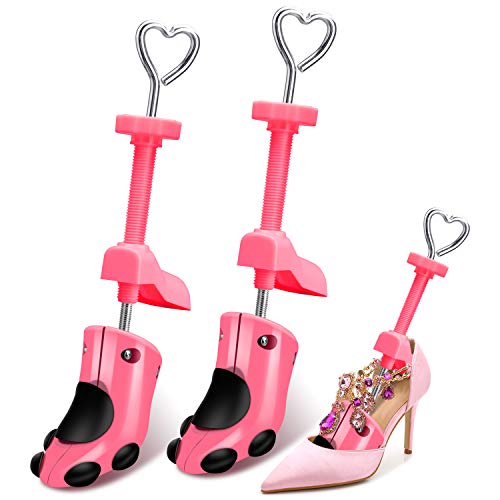
Best for: Women stretching snug high heels
The XYH shoe stretcher is a pair of adjustable inserts for women’s shoes in U.S. sizes 4.5 through 12. Each unit uses a polyurethane plastic body and a steel shaft. Its four-way adjustment targets both length and width, which gives it more control than a simple width-only stretcher. The package also includes eight plugs for pressure points such as bunions or corns.
Use the knob to expand the insert gradually, then leave it inside the shoe for 12 to 24 hours. Several sessions may be needed for noticeable changes, especially with stiff leather or synthetic materials. At around $23, this kit offers useful adjustment for under $25. The listing calls it a women’s model, despite the product title mentioning women and men, so buyers should check their shoe shape and size before ordering. A 90-day warranty adds some purchase protection, but it cannot correct shoes that are fundamentally too small.
Pros
- Fits women’s U.S. sizes 4.5 to 12, covering a broad range of common footwear.
- Four-way adjustment works on shoe length and width, not just side-to-side space.
- Eight removable plugs focus stretching around bunions, corns, or other pressure points.
Cons
- The stated sizing is for women’s shoes, so men may find the shape or fit unsuitable.
- Stretching takes 12 to 24 hours per session and may require repeated use for tight shoes.
1. UHIAGREE Wooden Shoe Stretcher

Best for: Relieving pressure in everyday shoes
The UHIAGREE Wooden Shoe Stretcher uses a four-way adjustment system to add length and width where shoes feel tight. Its wooden body is designed for repeated use, while the plastic ring and J-shaped metal handle control the fit. The listed M size covers men’s US 6.5–10 and women’s US 10–13.5, although the product title also references sizes 9–13. Check your shoe measurements before ordering.
Insert the stretcher with the heel aligned, then turn the plastic ring clockwise to lengthen the shoe. Turn the metal handle to widen the toe area and relieve pressure along the sides. The tool can also help smooth creases and reduce upper deformation in leather shoes, flats, and some athletic shoes. At around $21, it offers a low-cost option for occasional shoe care. It is not designed for boots, and it may work best on shoes with flexible uppers.
Pros
- Four-way adjustment targets both cramped toes and narrow sides.
- Wooden construction provides a sturdy alternative to basic plastic stretchers.
- Can help reduce pressure points, creases, and upper distortion.
Cons
- Not suitable for boots, according to the product instructions.
- The sizing information is inconsistent, so buyers should verify the fit before purchase.
Buying Guide
The most important factor is a roomy, adjustable fit across the foot’s top. Extensor tendons run beneath that area, so tight laces, stiff tongues, and narrow uppers can add pressure during long periods of standing or walking.
- Toe-box width: Choose a rounded or square front with at least 10–12 mm of space beyond the longest toe. Your toes should not touch the sides.
- Lacing and closure: Prefer eyelet lacing, elastic panels, or buckles that let you reduce pressure over the instep. Avoid fixed, tight slip-on bands.
- Heel height: Keep the heel at 1 inch or lower. A 0.5–1-inch lift usually creates less forefoot strain than a 2-inch dress heel.
- Upper material: Select soft leather, suede, or fabric with few seams across the top. Avoid rigid patent leather and raised stitching over the tendon area.
- Sole and cushioning: Look for a cushioned insole, flexible forefoot, and rubber outsole with an 8–12 mm heel-to-toe drop. A removable insole can fit orthotics.
If you cannot get every feature, prioritize a roomy fit with adjustable pressure across the instep.
Frequently Asked Questions
How should dress shoes fit with extensor tendonitis?
Choose dress shoes with a roomy toe box, soft uppers, low heels, and adjustable closures to reduce pressure across the top of your foot. Look for leather or fabric that bends easily, plus at least 10 to 15 millimeters of space beyond your longest toe. Avoid stiff tongues and tight laces.
What heel height is safest for sore foot tendons?
A dress shoe with a heel of about 1 inch or less is usually a better choice because it limits forward pressure on the forefoot and top of the foot. A flat, cushioned sole can also help, but avoid thin soles that transmit hard-floor impact. Test fit late in the day.
Can I wear formal shoes with extensor tendonitis?
You can wear formal footwear with extensor tendonitis when it fits without rubbing, pinching, or increasing pain, but severe or worsening symptoms call for medical advice. Start with short periods, such as 30 minutes, and switch to supportive casual shoes if discomfort rises. Adjustable straps often give more room than fixed laces.
Are loafers good shoes for extensor tendonitis?
Loafers can work for extensor tendonitis when they have a wide toe box, flexible upper, and supportive sole, but slip-on styles may slide and force your toes to grip. Choose a secure fit with roughly 10 millimeters of toe room, and skip pairs that press across the lace area or top of your foot.
Conclusion
UHIAGREE Wooden Shoe Stretcher is the top pick for shoppers who already own dress shoes and need adjustable space across a tight upper. If your priority is immediate comfort from a new pair, choose a soft leather style with a wide, rounded toe box instead of relying on a stretcher. Before buying, double-check the stretcher’s size range, compatibility with your shoe shape, whether you need one or two units, and the current price. A stretcher can help fine-tune fit, but it cannot fix every source of foot pain or replace professional advice. Look for low-pressure fit, secure lacing, and enough room above the toes. Stop wearing any pair that increases pain, numbness, or swelling.